
14 Inch Capacitive Touch Screen Supplier: The Definitive 2026 Guide
News
Mar-15-2026
Finding a reliable 14 inch capacitive touch screen supplier is a critical step for engineers and product managers building next-generation industrial terminals, medical consoles, and interactive retail kiosks. This 14-inch form factor has surged in popularity because it perfectly fills the gap between compact 10-inch screens and large-scale monitors. As we navigate the technical requirements of 2026, selecting a partner who understands Projected Capacitive (PCAP) technology, EMI shielding, and custom glass treatments is no longer optional—it is a baseline for product success.
In my experience auditing hardware supply chains, I have seen brilliant software crippled by a "bargain" touch sensor. A screen that jitters under electrical noise or fails after six months of cleaning is a liability. By partnering with a specialized 14 inch capacitive touch screen supplier, you ensure your device maintains the high-fidelity response users now expect from professional equipment.
How to choose the right 14 inch capacitive touch screen supplier?
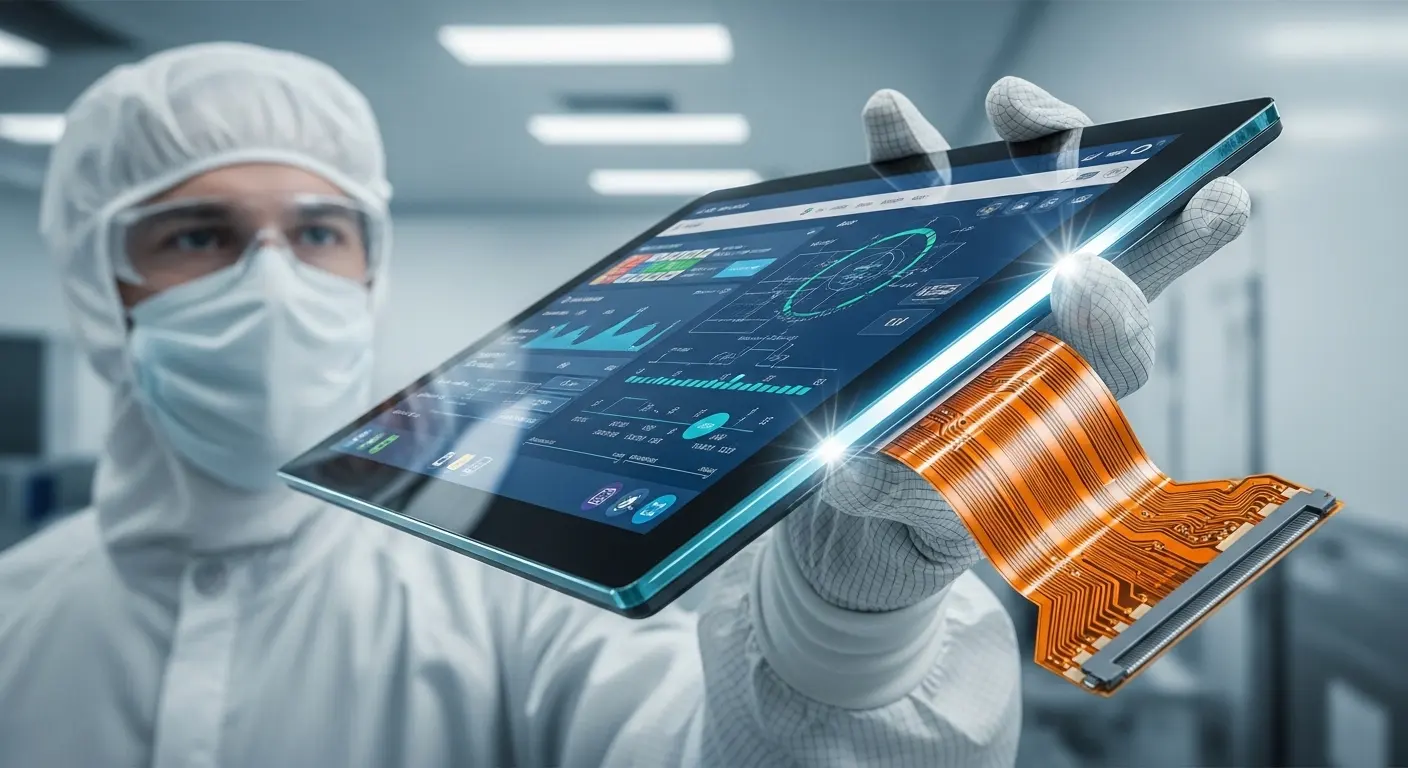
To choose the right 14 inch capacitive touch screen supplier, you must evaluate their technical expertise, customization capabilities, and long-term supply stability. A top-tier supplier should offer in-house optical bonding, firmware tuning for glove and water rejection, and certifications like ISO 9001. They must also guarantee component longevity to avoid costly mid-lifecycle redesigns.
When I first consulted for a high-end medical device firm, they struggled with a supplier who couldn't explain their "ghost touch" issues. We eventually moved to a partner who provided deep-level firmware support. That experience taught me that the "brain" of the touch screen—the controller IC—is just as important as the glass itself. A quality supplier will work with you to tune the sensor for your specific housing and environmental conditions.
Critical Evaluation Factors for Suppliers:
- Technical Support Depth: Can they provide the Linux or Android drivers you need?
- Customization Range: Do they offer custom capacitive touch screen options like AG/AR/AF coatings?
- Supply Chain Continuity: Will this specific 14-inch model be available for the next five years?
- Quality Control: Do they perform 100% functional testing in a Class 1000 cleanroom?
What makes a 14-inch PCAP display superior for modern HMIs?
A 14-inch PCAP display is superior for modern HMIs because it offers 10-point multi-touch, exceptional optical clarity, and high durability under a solid glass surface. Unlike resistive screens, PCAP technology does not require pressure to register a touch, allowing for fluid gestures like swiping and zooming. This technology is also resistant to environmental factors like dust, moisture, and chemical cleaners.
In today’s industrial landscape, "good enough" is a recipe for failure. Operators are used to the responsiveness of their personal tablets. If your 14-inch interface feels laggy, user error rates will climb. While smaller screens like the 10.1 inch tft lcd touch display are great for handhelds, the 14-inch widescreen provides the necessary space for complex dashboards without the bulk of a 21.5 inch touch screen.
Comparison: PCAP vs. Resistive in Industrial Use
| Feature | PCAP (Projected Capacitive) | Resistive (Legacy) |
| Touch Points | 10+ Points (Multi-touch) | Single Touch Only |
| Surface Material | Hardened Glass (6H-7H) | Soft Plastic Film |
| Transparency | >85% (High Clarity) | ~75% (Cloudy) |
| Durability | Millions of touches | Wear and tear issues |
What are the critical technical specifications for 14-inch touch screens?
Critical technical specifications for 14-inch touch screens include a Full HD (1920x1080) resolution, a high-quality controller IC (like ILITEK or EETI), and an I2C or USB interface. You should also verify the cover glass thickness, typically ranging from 1.1mm to 3.0mm depending on the impact requirements. Operating temperature ranges should ideally support at least -20°C to +70°C for industrial reliability.
I once reviewed a project where a 14-inch screen failed simply because the bezel design put too much pressure on the edges of the sensor. A knowledgeable custom projected capacitive and resistive touch screen distributor would have flagged this during the CAD review.
Mandatory Specs for 2026 Projects:
- Controller: Industrial-grade (e.g., ILITEK 2511 or similar).
- Interface: USB for plug-and-play or I2C for embedded systems.
- Aspect Ratio: 16:9 is the standard for 14-inch modules.
- Signal-to-Noise Ratio (SNR): High SNR is vital to filter out EMI from factory machinery.
Why is customization essential when selecting a touch screen supplier?
Customization is essential because every industrial environment presents unique challenges, such as direct sunlight, heavy moisture, or the need for thick work gloves. A specialized supplier can provide custom cover glass, specific silk-screen printing for branding, and specialized surface treatments. This ensures the touch screen integrates perfectly with your brand's aesthetic and your hardware's functional requirements.
One of the most frequent requests I see is for Anti-Glare (AG) coating. If your device sits under bright fluorescent factory lights, a standard glossy screen becomes a mirror. By working with a 12.1 inch capacitive touch screen manufacturers or 14-inch specialist, you can specify an etched AG surface that kills reflections while maintaining touch sensitivity.
Tip: If your device is for public use, ask for Anti-Fingerprint (AF) coating. It significantly reduces the "smudge" factor and makes the screen much easier to clean at the end of a shift.
How does optical bonding impact 14-inch screen performance?
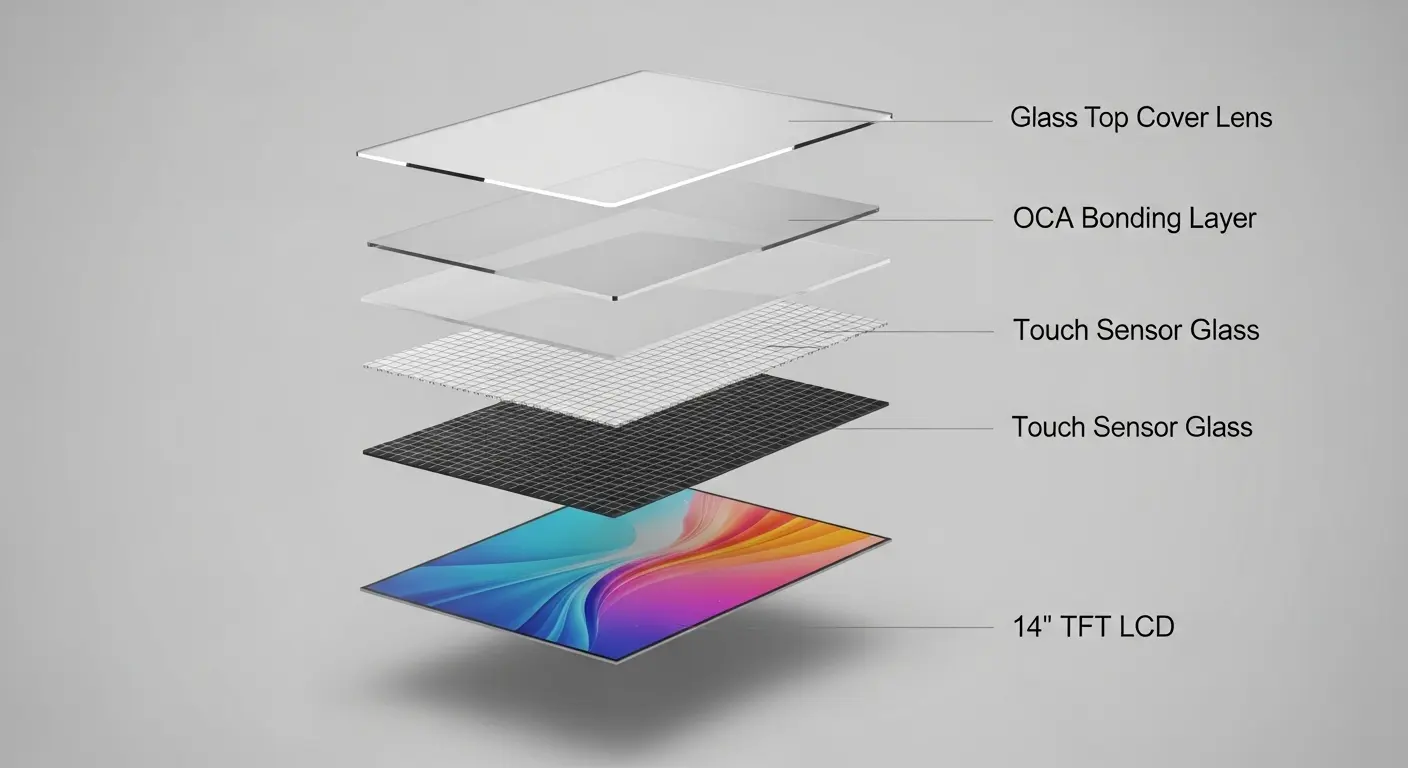
Optical bonding impacts 14-inch screen performance by eliminating the air gap between the touch sensor and the LCD. This process involves using a clear resin to fuse the layers together. It drastically reduces internal reflections, improves contrast by up to [00%], and prevents condensation from forming between the layers in high-humidity or temperature-shifting environments.
I highly recommend optical bonding for any screen used outdoors or in medical settings. I’ve seen non-bonded screens fog up internally after being moved from a cold warehouse to a warm office. Optical bonding makes the entire display assembly a solid block, which also increases its physical impact resistance.
Benefits of Optical Bonding:
- Superior Readability: Best for sunlight-readable requirements.
- Durability: Increases shock and vibration resistance.
- Dust Prevention: No air gap means no dust can ever get trapped under the glass.
- Parallax Elimination: The touch point and the image are perfectly aligned.
Which industries benefit most from 14-inch capacitive displays?
Industries that benefit most from 14-inch capacitive displays include medical diagnostics, high-end industrial automation, and professional retail kiosks. The 14-inch size offers enough "real estate" to show detailed patient vitals or complex machine schematics while remaining small enough for cart-mounted or wall-mounted installations. It is also the perfect size for premium "Self-Checkout" terminals in modern retail stores.
In the medical field, the 14-inch screen is a favorite for mobile diagnostic carts. It allows doctors to see high-resolution imagery without having to lug around a full-sized monitor.
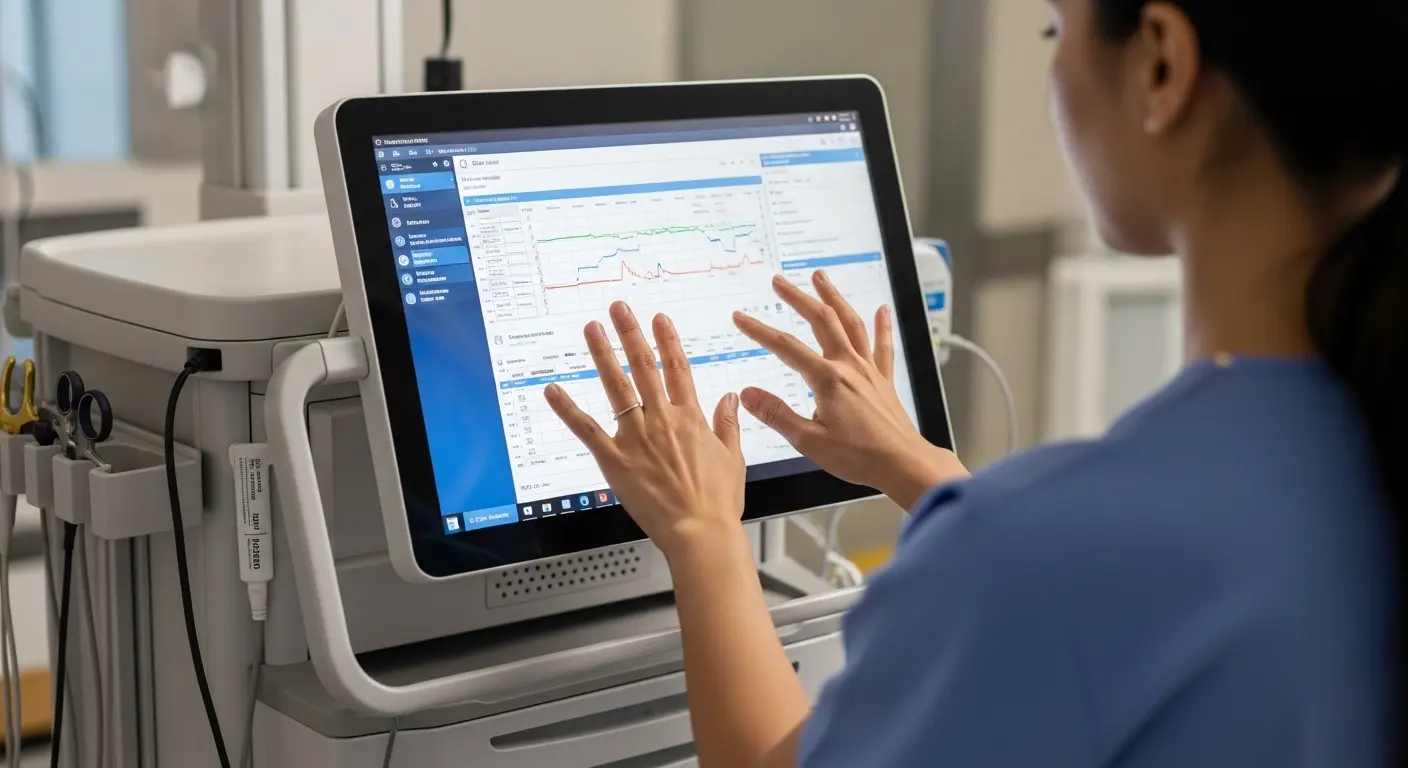
- Medical: Ultrasound machines, bedside monitors, and lab equipment.
- Industrial: PLC interfaces, CNC controllers, and factory automation dashboards.
- Retail: High-end POS systems and interactive wayfinding kiosks.
What are the most common integration mistakes with 14-inch screens?
The most common integration mistakes include poor grounding of the FPC tail, ignoring EMI from the display backlight, and failing to account for mechanical bezel pressure. These errors lead to "ghost touches" or areas of the screen that become unresponsive. Proper integration requires a holistic approach where the touch controller, the display, and the chassis are treated as a single electrical system.
Tip: Use shielded cables for the touch interface. I have solved countless "erratic touch" issues simply by replacing a standard unshielded USB cable with a high-quality shielded one.
Integration Checklist:
- Grounding: Is the touch panel tail grounded to the main chassis?
- Clearance: Is there at least a 0.5mm gap between the bezel and the active touch area?
- Power: Does the touch controller have a clean, regulated 5V or 3.3V supply?
- Firmware: Has the manufacturer tuned the "Noise Threshold" for your specific display?
How do you verify the reliability of a 14 inch capacitive touch screen supplier?
To verify a 14 inch capacitive touch screen supplier, you should request their failure rate data (RMA rates), ask for reference customers in your specific industry, and audit their testing procedures. A reliable supplier will perform environmental stress tests, including salt spray, high-temperature storage, and humidity cycling. They should also provide a transparent "PCN" (Product Change Notification) policy to alert you to any component changes.
I always tell my clients to ask for the "MTBF" (Mean Time Between Failures) of the backlight and the touch controller. A supplier who can't provide these numbers likely isn't performing enough long-term reliability testing.
Final Thought
Choosing a 14 inch capacitive touch screen supplier is a strategic decision that affects your product's entire lifecycle. In 2026, the interface is the most visible part of your brand's technology. By prioritizing technical specs like optical bonding and custom coatings, and by choosing a partner with a deep history in custom capacitive touch screen development, you build a product that is as durable as it is intuitive.
Related Topics

Industrial Touch Display Technology Trends in the Era of Industry 4.0
Aug-07-2026

Touch Panel Selection Guide for Industrial, Outdoor, and Commercial Applications
Aug-07-2026

How to Choose the Right Touch Display Solution for Your Project
Aug-07-2026

How to Choose an Industrial Capacitive Touch Screen: 2026 Guide
Aug-07-2026
Get a Free Quote
✔ 16 Years Manufacture Service ★★★★★
✔ 3 Technical Experts And 52+ Project Engineers Will Assiste You
✔ Wanty Employs Over 52 Engineers, Many Of Whom Come From Leading Tft Lcd Module Companies Such As Tianma And Boe-Varitronix. Each Core Team Member Brings 15 Years Of Industry Experience.
✔ If you would like more information about our products and services, please contact us. Whether you need a standard solution or a customized one, we are here to meet your needs.
✔ Please complete the form below, and the selected location will contact you promptly. Thank you for visiting, and have a great day!
