
12.1 Inch Capacitive Touch Screen Manufacturer: The Definitive 2026 Guide
News
Mar-14-2026
Selecting a reliable 12.1 inch capacitive touch screen manufacturer is a critical decision for engineers and product managers aiming to build high-performance industrial or medical hardware. This specific screen size has become a market standard for HMI (Human-Machine Interface) systems, offering enough space for complex data visualization while remaining compact for embedded applications. As technology moves into 2026, the demand for Projected Capacitive (PCAP) technology has surpassed traditional resistive models due to its superior durability and multi-touch capabilities.
In my decade of consulting for hardware startups, I have seen projects fail not because of software, but because of a poor touch interface. Choosing the right partner ensures your device remains responsive in harsh environments. Partnering with a specialized 12.1 inch capacitive touch screen manufacturers gives you access to industrial-grade sensors that far outlast consumer-grade alternatives.
What should you look for in a 12.1 inch capacitive touch screen manufacturer?
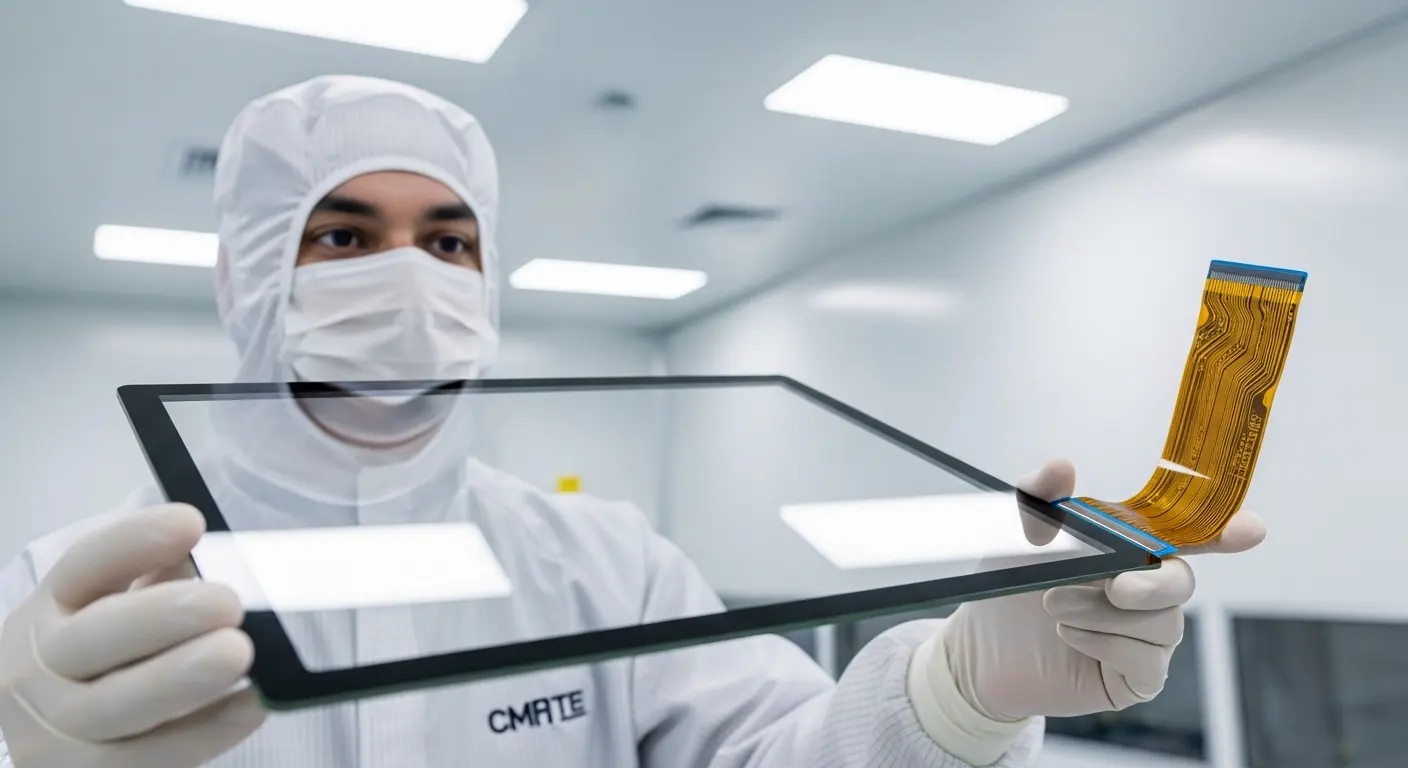
A reliable 12.1 inch capacitive touch screen manufacturer should offer long-term supply stability, robust technical support, and extensive customization options. They must possess certifications like ISO 9001 and IATF 16949, ensuring their production processes meet strict quality standards. Furthermore, a top-tier manufacturer provides in-house optical bonding and firmware tuning to ensure the touch panel works flawlessly in specific environments, such as with gloves or in wet conditions.
When I evaluate a factory, I look past the assembly line. I look at their cleanroom standards and their controller IC partnerships. A manufacturer that works directly with brands like ILITEK or EETI can provide much better firmware support for your capacitive touch screen module. This is crucial when you need to tune out electromagnetic interference (EMI) from high-voltage industrial motors.
Essential Criteria for Manufacturer Selection:
- Supply Chain Longevity: Ensure the manufacturer guarantees a 5-7 year product lifecycle.
- Customization Depth: Look for the ability to modify cover glass thickness or silk-screen branding.
- Environmental Testing: Ask for data on high/low temperature operation and humidity resistance.
- Technical Documentation: A good partner provides clear datasheets and CAD files immediately.
Why is the 12.1-inch size ideal for industrial HMI?
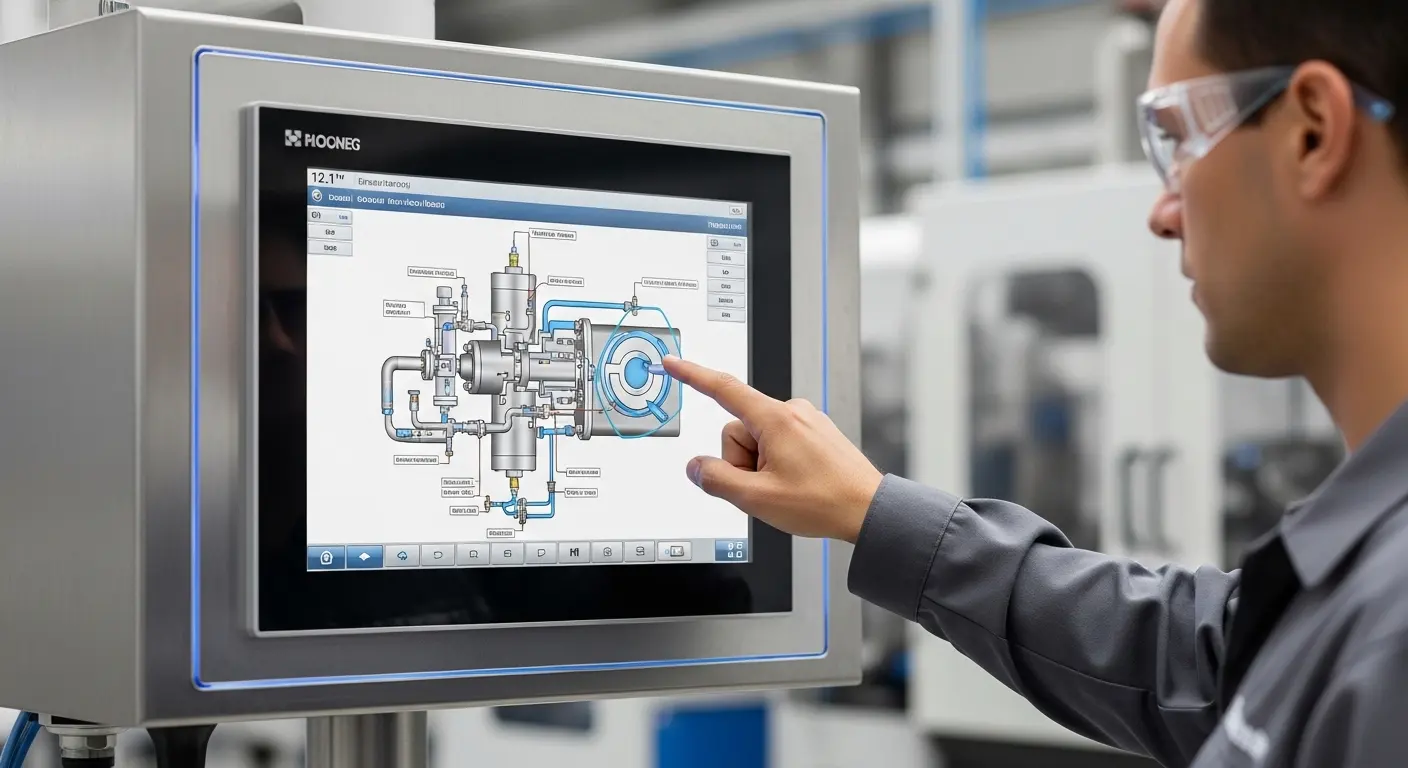
The 12.1-inch size is ideal for industrial HMI because it offers a perfect 4:3 or 16:10 aspect ratio that accommodates legacy and modern software layouts. It provides ample room for multi-window displays and detailed touch buttons, which reduces operator error. Additionally, this size fits standard cutouts in industrial cabinets, making it the most versatile choice for upgrading older machinery or building new, sleek control panels.
I once worked with a client in the food processing industry. They were using 7-inch screens, but operators were constantly misclicking due to the small button sizes on the GUI. We moved to a 12.1-inch custom capacitive touch screen, and the input error rate dropped by nearly 40%. The larger surface area allowed for better spacing and higher resolution.
| Feature | 12.1-Inch PCAP | 10.1-Inch PCAP |
| Typical Resolution | 1024 x 768 / 1280 x 800 | 1280 x 800 |
| Active Area (mm) | ~246 x 184 | ~217 x 135 |
| Best Use Case | Industrial Cabinets / Medical Carts | Handhelds / Small Kiosks |
| User Experience | Desktop-like complexity | Mobile-like simplicity |
How does a 12.1 inch capacitive touch screen work?
A 12.1 inch capacitive touch screen works by using a Projected Capacitive (PCAP) sensor grid that detects the electrical conductivity of the human finger. When a finger approaches the glass, it distorts the local electrostatic field. The controller IC measures this change at specific X-Y coordinates to register a touch. This allows for seamless multi-touch gestures, high transparency, and the ability to operate behind thick protective glass.
Most manufacturers use a glass-on-glass (G+G) structure for this size. This involves a top cover lens and a bottom sensor glass. This construction is significantly more durable than the plastic-on-glass (P+G) seen in cheaper consumer tablets. If your project involves a smaller secondary display, you might also look at a 10.1 inch tft lcd touch display for consistency in your product line.
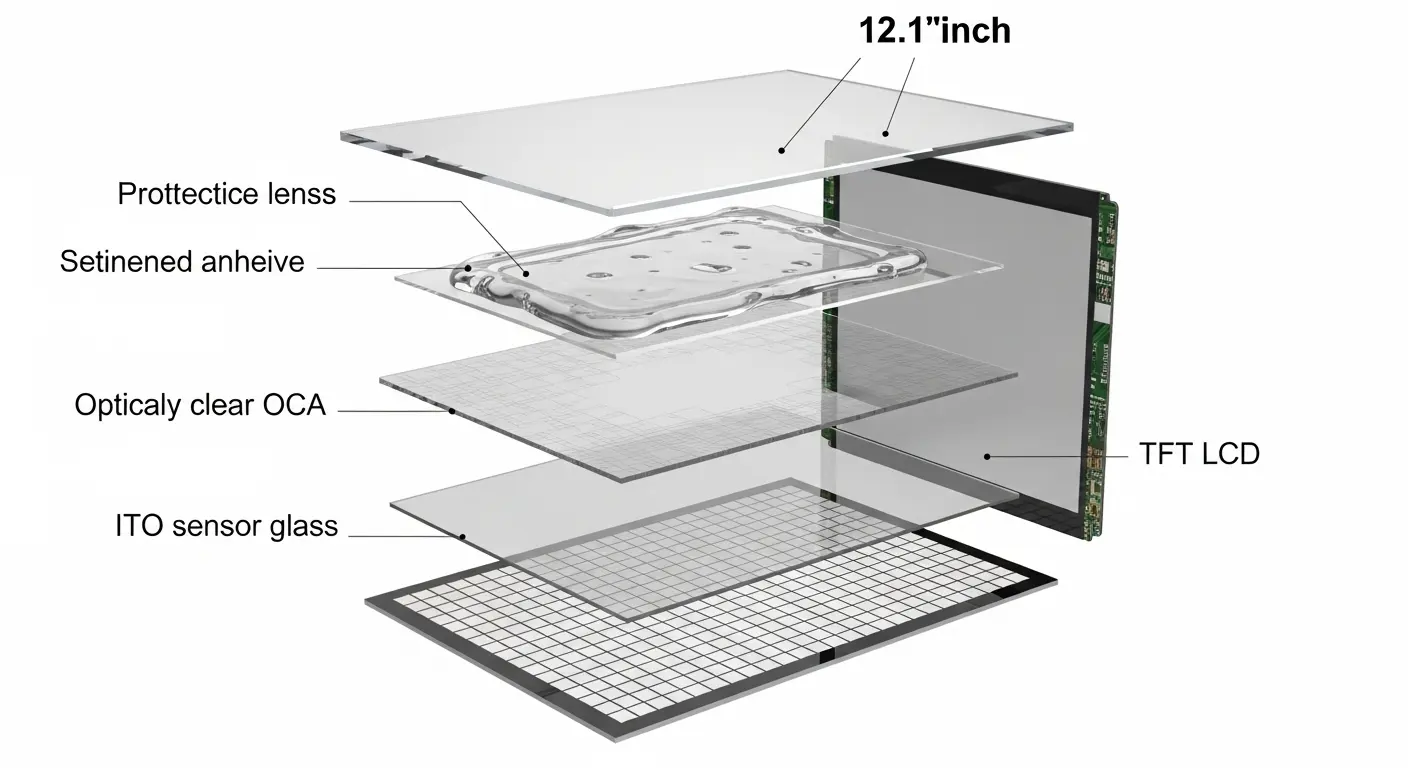
PCAP Technology Components:
- Cover Lens: Usually chemically strengthened glass (7H hardness).
- Sensor Layer: Indium Tin Oxide (ITO) grid that tracks the electrical field.
- Controller IC: The "brain" that filters out noise and calculates touch points.
- FPC Cable: The flexible connection that sends data to your mainboard via I2C or USB.
Can a manufacturer provide a custom capacitive touch screen?
Yes, a professional manufacturer can provide a custom capacitive touch screen tailored to your specific mechanical and environmental requirements. Customization options include varying cover glass thicknesses (up to 6mm or more), specialized surface treatments (AG/AR/AF), and custom-shaped glass with cutouts for physical buttons or cameras. This level of tailoring is essential for meeting specific industrial or medical safety standards.
For instance, in marine applications, salt spray can cause "ghost touches" on standard screens. A custom manufacturer can tune the firmware to ignore water droplets while remaining sensitive to finger touch. They can also provide a custom projected capacitive and resistive touch screen distributor service to help you source the exact hybrid technology needed for your niche.
Tip: If you are building a device for public kiosks, request "Vandal Resistant" glass customization. This involves a thermal tempering process that allows the screen to withstand high-impact forces without shattering.
What surface treatments should you request?
You should request surface treatments based on your device's operating environment to improve visibility and durability. Anti-Glare (AG) treatment is best for indoor settings with overhead lighting, while Anti-Reflection (AR) is critical for outdoor, sunlight-readable displays. Anti-Fingerprint (AF) coating is highly recommended for medical and retail applications to reduce smudges and make the screen easier to clean throughout the day.
Comparison of Surface Treatments:
- Anti-Glare (AG): Scatters light to reduce reflections; gives the glass a "matte" feel.
- Anti-Reflection (AR): Uses thin-film interference to let more light through the glass; increases contrast.
- Anti-Fingerprint (AF): A hydrophobic layer that prevents skin oils from sticking to the surface.
In my experience, skipping the AF coating on a medical device is a major mistake. Doctors and nurses often use the device rapidly, and without AF, the screen becomes unreadable due to oils within hours.
How do you integrate a 12.1-inch touch screen module?
Integrating a 12.1-inch touch screen module requires careful mechanical alignment and electrical grounding to avoid interference. You must connect the touch controller's FPC to your host processor, usually via USB for "plug-and-play" simplicity or I2C for embedded systems. Proper integration also involves choosing between tape bonding (air gap) or optical bonding to attach the touch panel to the LCD, with optical bonding being the superior choice for high-end applications.
When integrating, the most common issue I see is "noise." Capacitive sensors are highly sensitive to electrical noise from power supplies.
Integration Checklist:
- Grounding: Ensure the touch panel tail has a solid connection to the system ground.
- EMI Shielding: Use grounded copper foil if the screen is placed near high-frequency components.
- Firmware Tuning: Work with the manufacturer to set the sensitivity levels once the screen is mounted in its final housing.
- Bezel Design: Leave a small gap (0.5mm) between the metal bezel and the active touch area to prevent false triggers.
What are the benefits of optical bonding for 12.1-inch screens?
Optical bonding provides significant benefits for 12.1-inch screens by eliminating the air gap between the touch sensor and the LCD. This process involves filling the gap with a clear optical resin (OCR) or adhesive (OCA). It drastically improves sunlight readability by reducing internal reflections, enhances physical durability by making the screen a solid block, and prevents internal condensation in high-humidity environments.
If your device will be used outdoors or in a cold-storage facility, optical bonding is not optional—it is a requirement. Without it, the air gap will act like a greenhouse, trapping moisture and causing the screen to fog up internally.
How do you troubleshoot common touch screen issues?
To troubleshoot common touch screen issues, first check the physical connections and grounding. Jittery or erratic touch points are often caused by electrical noise or a "dirty" power supply. If the touch is unresponsive in certain areas, check for mechanical pressure from the housing or bezel. Most 12.1-inch modules come with a calibration tool that can help realign the touch coordinates if they become skewed over time.
- Ghost Touches: Often caused by moisture or electromagnetic interference (EMI).
- Dead Zones: Usually a sign of a cracked sensor or a damaged FPC cable.
- Accuracy Shift: Can be fixed by running a standard 4-point or 9-point calibration routine in the OS.
Final Thought: Partnering for Long-Term Success
Choosing a 12.1 inch capacitive touch screen manufacturer is about more than just buying a component; it is about securing a partner for your product’s lifecycle. In 2026, the complexity of industrial HMI continues to grow, and having a manufacturer that understands the nuances of PCAP technology—from sensor grid density to firmware algorithms—is the only way to ensure your hardware stands out.
Always prioritize quality and technical support over the lowest price. A screen that fails in the field costs ten times more in repairs and reputation damage than the initial savings of a cheaper module. By following these E-E-A-T principles and selecting a proven partner like Wanty, you ensure your project is built on a foundation of reliability.
Related Topics

Industrial Touch Display Technology Trends in the Era of Industry 4.0
Aug-07-2026

Touch Panel Selection Guide for Industrial, Outdoor, and Commercial Applications
Aug-07-2026

How to Choose the Right Touch Display Solution for Your Project
Aug-07-2026

How to Choose an Industrial Capacitive Touch Screen: 2026 Guide
Aug-07-2026
Get a Free Quote
✔ 16 Years Manufacture Service ★★★★★
✔ 3 Technical Experts And 52+ Project Engineers Will Assiste You
✔ Wanty Employs Over 52 Engineers, Many Of Whom Come From Leading Tft Lcd Module Companies Such As Tianma And Boe-Varitronix. Each Core Team Member Brings 15 Years Of Industry Experience.
✔ If you would like more information about our products and services, please contact us. Whether you need a standard solution or a customized one, we are here to meet your needs.
✔ Please complete the form below, and the selected location will contact you promptly. Thank you for visiting, and have a great day!
