
Touch Panel Selection Guide for Industrial, Outdoor, and Commercial Applications
Technology News
Aug-07-2026
In today’ s rapidly evolving smart device landscape, touch panels are no longer just an interface component—they have become a critical factor influencing system reliability, user experience, and overall product competitiveness.
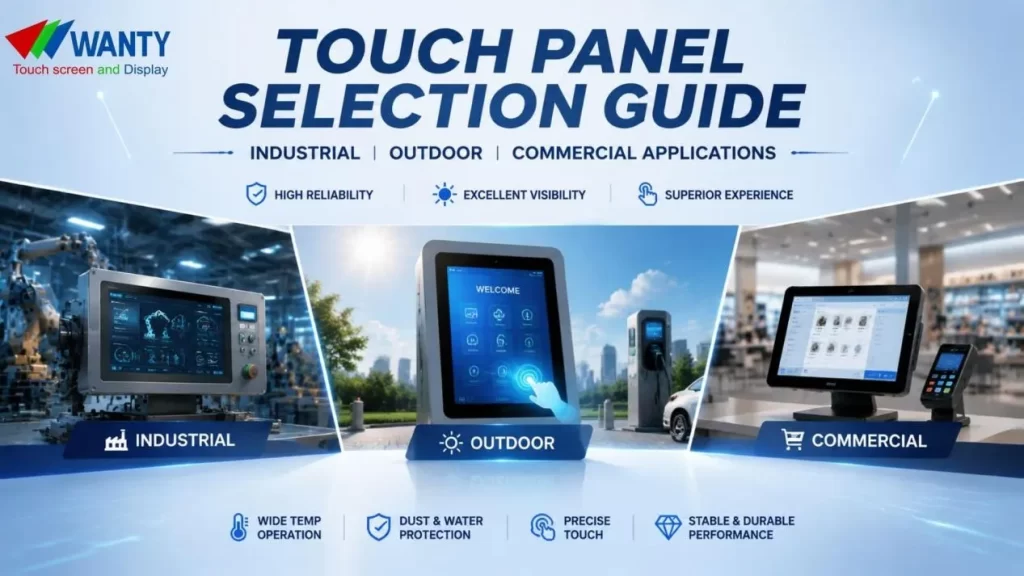
However, selecting the right touch solution is not a one-size-fits-all decision. Industrial, outdoor, and commercial applications each present very different environmental and functional requirements.
In this article, we share a practical selection guide based on real-world application scenarios.
1. Before Choosing: Understanding Core Touch Technologies
Before diving into applications, it is important to understand the main touch technologies and where they fit best.
Capacitive Touch
Fast response and smooth multi-touch experience
High transparency and excellent display quality
Ideal for commercial and smart devices
Requires optimization for gloves or wet conditions
Resistive Touch
Works with gloves and stylus input
Better performance in harsh or contaminated environments
Lower cost but limited multi-touch experience
More common in industrial legacy systems
Infrared / SAW Solutions
Suitable for large-size or public interactive systems
Not dependent on surface pressure
Can be affected by dust or obstruction
Each technology has its strengths—the key is matching it with the application environment.
2. Industrial Applications: Reliability Comes First
Industrial environments are often the most demanding, with challenges such as dust, oil, vibration, and electromagnetic interference.
Key selection considerations:
High reliability and continuous operation
Industrial equipment typically runs 24/7, requiring stable performance over long cycles.
Strong EMI/EMC resistance
Electromagnetic interference from motors and power systems must be carefully managed.
Wide operating temperature range
Usually expected to function reliably from -20°C to 70°C or even wider.
Support for gloves and wet operation
Operators rarely use bare fingers in real environments.
High protection level
IP65 or above is commonly required to ensure resistance to dust and moisture.
In industrial design, stability always outweighs aesthetics.
3. Outdoor Applications: Visibility and Environmental Resistance
Outdoor touch applications include EV charging stations, kiosks, transportation systems, and outdoor advertising displays.
Key challenges and solutions:
High brightness visibility
Sunlight readability is critical, typically requiring 1000 nits or higher.
Anti-reflection and optical bonding
Optical bonding helps improve contrast and reduces internal light reflection.
Water and dust protection
IP65–IP67 protection ensures stable operation under rain and dust exposure.
Temperature and UV resistance
Materials must withstand both extreme heat and cold, while resisting long-term UV degradation.
Impact resistance
Public-facing systems require reinforced glass and anti-vandal designs.
Outdoor performance is defined by environmental endurance rather than pure display quality.
4. Commercial Applications: Experience and Design Matter Most
Commercial devices include POS systems, financial terminals, education devices, and conference panels.
Key focus areas:
Smooth and responsive interaction
Low latency and precise touch tracking directly impact user satisfaction.
High-resolution display quality
Wide color gamut and sharp visuals improve content presentation.
Slim and modern design
Narrow bezels and thin structures are preferred for commercial aesthetics.
System compatibility
Support for Android, Windows, and Linux ensures flexible integration.
Long-term operational stability
Devices must remain stable under continuous daily usage.
In commercial applications, user experience is the primary competitive factor.
5. A Practical Framework for Touch Panel Selection
To simplify decision-making, we can evaluate touch panels through five key dimensions:
1. Environmental adaptability
Temperature, humidity, UV exposure, and EMC performance
2. Interaction performance
Response speed, accuracy, and multi-touch capability
3. Optical performance
Brightness, contrast, transparency, and reflection control
4. Structural reliability
Glass structure, bonding technology, and impact resistance
5. Lifecycle and supply stability
Durability, consistency, and long-term availability
This framework helps align technical specifications with real-world application needs.
Related Topics

Industrial Touch Display Technology Trends in the Era of Industry 4.0
Aug-07-2026

Touch Panel Selection Guide for Industrial, Outdoor, and Commercial Applications
Aug-07-2026

How to Choose the Right Touch Display Solution for Your Project
Aug-07-2026

How to Choose an Industrial Capacitive Touch Screen: 2026 Guide
Aug-07-2026
Get a Free Quote
✔ 16 Years Manufacture Service ★★★★★
✔ 3 Technical Experts And 52+ Project Engineers Will Assiste You
✔ Wanty Employs Over 52 Engineers, Many Of Whom Come From Leading Tft Lcd Module Companies Such As Tianma And Boe-Varitronix. Each Core Team Member Brings 15 Years Of Industry Experience.
✔ If you would like more information about our products and services, please contact us. Whether you need a standard solution or a customized one, we are here to meet your needs.
✔ Please complete the form below, and the selected location will contact you promptly. Thank you for visiting, and have a great day!
