
Capacitive or resistive touchscreen — which should you choose?
Technology News
Aug-07-2026
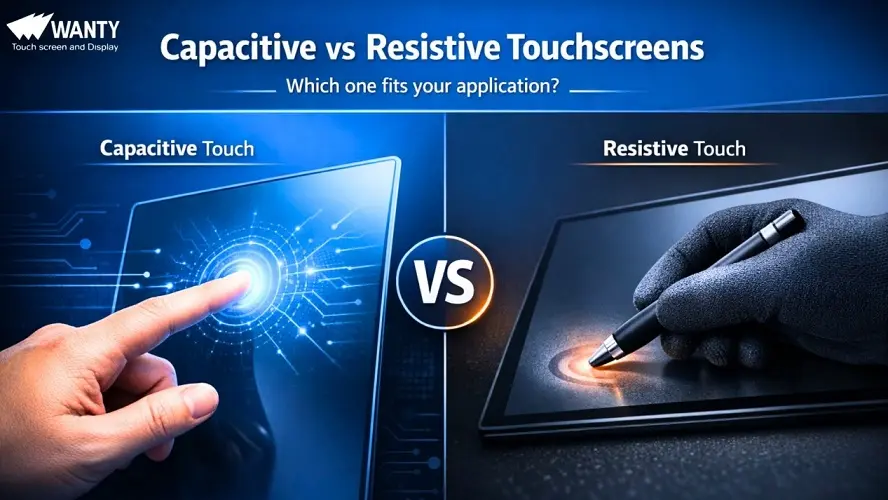
Capacitive vs Resistive Touchscreens
Touchscreen technology has advanced rapidly over the past few years, offering a wide variety of options for consumers and businesses alike. Among the most common types available today are capacitive and resistive touchscreens, each with distinct characteristics.
For industrial applications, selecting the right touchscreen is crucial to ensure efficiency, accuracy, and durability. The experts at Shenzhen Wanty provide a detailed overview of the differences between capacitive and resistive touchscreens, helping you choose the solution best suited for your needs.
Resistive Touchscreens
Resistive touchscreens are pressure-based devices that detect touch through physical contact with the screen surface. They consist of two ITO-coated conductive layers separated by insulating spacer dots, with a flexible top layer and a rigid glass bottom layer. When pressed by a finger or stylus, the layers make contact and the controller determines the touch position by measuring voltage changes.
One major advantage of resistive screens is their compatibility with any input method—fingers, gloved hands, stylus pens, or any object that can apply enough pressure without damaging the screen. This simple design also means fewer connections are required between the display and controller.
Traditionally, resistive touchscreens were widely used in industrial settings due to their cost-effectiveness. Typical applications include ATMs, medical devices, and point-of-sale card readers.
Capacitive Touchscreens
Capacitive touchscreens, in contrast, are made of glass coated with a transparent conductive material such as indium tin oxide. These screens rely on the electrical properties of the human body. When a finger or a conductive object touches the screen, the electrostatic field changes, registering the input.
Capacitive screens support advanced gestures such as swipes, pinches, and multi-touch functionality. While a standard stylus or glove won’t work unless conductive, they provide a more responsive and interactive experience.
Comparing Capacitive and Resistive Touchscreens
- Cost
Capacitive touchscreens are generally more expensive due to advanced technology and additional processing requirements. Resistive touchscreens, with simpler circuitry, are more budget-friendly.
- Durability and Impact Resistance
Resistive screens once cracked, their touch function fails. Capacitive screens are more prone to cracking upon impact, though touch functionality often remains even with surface damage. Additionally, their glass surfaces are highly scratch-resistant, making them durable over time.
- Touch Sensitivity and Contaminant Resistance
Capacitive screens respond to light touches and can detect multiple touch points simultaneously, making them ideal for modern interactive applications. However, this sensitivity also makes them more prone to registering false touches from moisture or dirt.
Resistive screens require firm pressure to register input and detect only single touches.
- Display Clarity
Capacitive screens offer superior image quality, sharper visuals, and higher contrast thanks to better light transmission. Resistive screens, with lower light transmission, provide comparatively dimmer and less vibrant images.
About Shenzhen Wanty
Shenzhen Wanty specializes in high-quality capacitive touchscreen solutions for industrial and commercial applications. Our products are designed for reliability, durability, and optimal performance in demanding environments. Contact us today to find the perfect touchscreen solution for your needs.
Related Topics

Industrial Touch Display Technology Trends in the Era of Industry 4.0
Aug-07-2026

Touch Panel Selection Guide for Industrial, Outdoor, and Commercial Applications
Aug-07-2026

How to Choose the Right Touch Display Solution for Your Project
Aug-07-2026

How to Choose an Industrial Capacitive Touch Screen: 2026 Guide
Aug-07-2026
Get a Free Quote
✔ 16 Years Manufacture Service ★★★★★
✔ 3 Technical Experts And 52+ Project Engineers Will Assiste You
✔ Wanty Employs Over 52 Engineers, Many Of Whom Come From Leading Tft Lcd Module Companies Such As Tianma And Boe-Varitronix. Each Core Team Member Brings 15 Years Of Industry Experience.
✔ If you would like more information about our products and services, please contact us. Whether you need a standard solution or a customized one, we are here to meet your needs.
✔ Please complete the form below, and the selected location will contact you promptly. Thank you for visiting, and have a great day!
